How will you win a chess game? by tactic or strategy? the correct answer is both, and you must learn these chess strategies and tactics together.
In this article, I will explain everything about chess strategy and chess tactics, and I will also try to explain how can you benefit from these two tools together.
What is a chess strategy?
In order to win chess game, you have to create a strategy, which is also called planing, without creating chess strategy you can not win.
For example if you are playing chess and you do not have a plan for attack or a plan for creating more weakness then how will you win? that’s why you must create a strategy or planning for winning chess game.
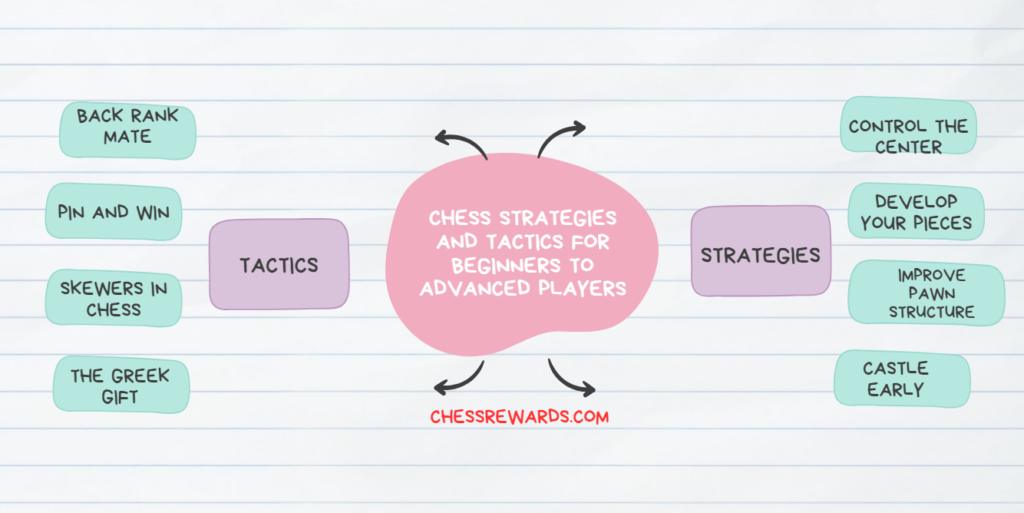
There are many chess strategies which works on almost any positions. I will list here some of the chess strategies which will work almost on all of your chess games, but remember that everything also has some exceptions.
Let’s learn these chess strategies with exemplary chess games.
Chess Strategies for Winning Chess Games
1. Control the Center
Control of the center especially in opening is necessary for all chess players, because that’s what the most important area of battles on the board.
What’s the benefit of controlling the center? Well the control on the center gives you power and space which will help you in the attack.
Here is an image of larger center.
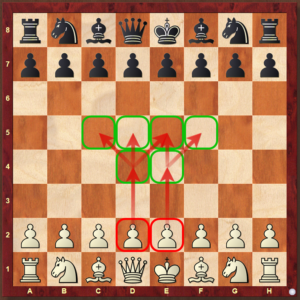
Let’s watch game below, which shows the power of controlling the center and how to get benefits from owned center.
Hats Off to Paul Morphy, now I hope you understand the power of the center. In the opening control the center with pawns, and If possible then bring all the powers to the center.
Let’s watch another chess game for learning importance of the center.
In above game, Karpov sacrificed b pawn in order to get fast development of his pieces. after that he dominated the center until he got winning chess position.
2. Develop Your Minor Pieces First
I have analysed many chess beginners’ games and that’s the number one mistake (they do not develop their minor pieces) they made in the opening.
In the opening, you must develop your pieces and do not move pawns until its forced.
If you have the choice to play the pawn move or piece then choose piece move above pawn move, which will surely give you the advantage.
Let’s watch chess game where white players develop his chess pieces and black did not develop properly.
Let’s watch another game, which shows the importance of piece development in the opening.
See how Capablanca centralized his pieces and then launched an attack on the king. Black has blundered to the checkmate but even if he defends he would have created more weakness.
3. Improve Your Pawn Structure
Learning pawn structure is one of the main topic for improvement especially if you are beginner.
Try to learn different pawn structures and master them, pawn structures also help in the middlegame for the decision of attack.
Let’s watch one game where black has isolated pawn and lost the game because of it.
In above game, white managed to isolated black’s d pawn and converted into winning position.
4. Castle Early When Possible
Castling in chess is one of the main opening task, why should we castle? we castle our king because it is in the center and that’s where most of fights begin, like e4 and e5, that’s why you should castle early in the opening and if you do it, you will get two benefits.
Number one is that you take your king into safety and second is that now your rooks will be connected.
Here is a chess games, where black was not castled early and faced deadly attack from white side.
In above chess game, white castled on move 4 and started the attack on black’s king and converted the advantage of early castling into a win.
5. Rook on Open Files
Rook endgames are one of most important topic in chess, you almost play rook endgame on every chess game.
The one thing you should keep in mind while playing rook endgame is that The Active Rook is better than a passive even if it costs you pawn or two pawn.
Here is the one chess game, where you will see how white activates his rook and make use of it.
That’s about the general rules of chess strategies, now you can use them in your practical chess games and you will get benefits of above knowledge.
Let’s learn about our second topic which is tactics.
How to Learn Tactics for Beginners
How many puzzle do you solve daily? and how much they help you in your real game? how many times you got a tactical position which you have solved in your tactic training?
I hope you got the point, just solving chess puzzles will not help you much and its very rare that you get a solved position on chess board.
So here question arises, how beginners should learn the tactics.
The answer is learn patterns and motifs, because that’s where you develop your logical understanding.
Now I will list some of patterns or motifs below, after studying these pattern you will able to do tactical shot if position arises in your chess games. And these motifs will also help you to solve tactical positions.
Back Rank Mate
This is often neglected checkmate pattern in beginners, when you see that your opponent’s king has castled and did not move one of pawn above the king, that’s where you must feel that there can be back rank checkmate.
Let me explain with the picture.
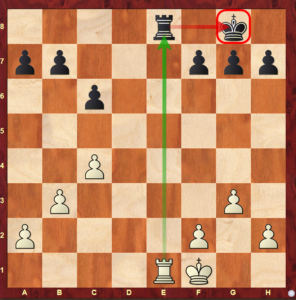
In above example white is to move, now white will take his rook and it will be back rank mate because his king can not escape from back rank.
Let’s see this back rank mating motif in action, let’s watch this chess game.
Back Rank Checkmate with Rook
I hope now you understand the motif of back rank and now you know what is the back rank and how to deliver it.
Pin and Win
There is one famous saying which is Pin and Win. That means when you pin your opponent’s piece then you must try win it.
Here is the picture of pin.
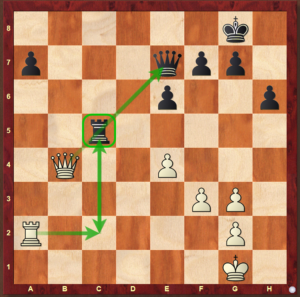
In above picture, its white to move and white will play rook to c2 and black is unable to capture that rook because his queen is pinned, if black protects its queen with king then his rook will take either with rook or queen.
So in conclusion, you have many opportunities in chess game where pin is possible but we do not think about it, from now on you will be aware of pin and its uses.
Skewers in Chess
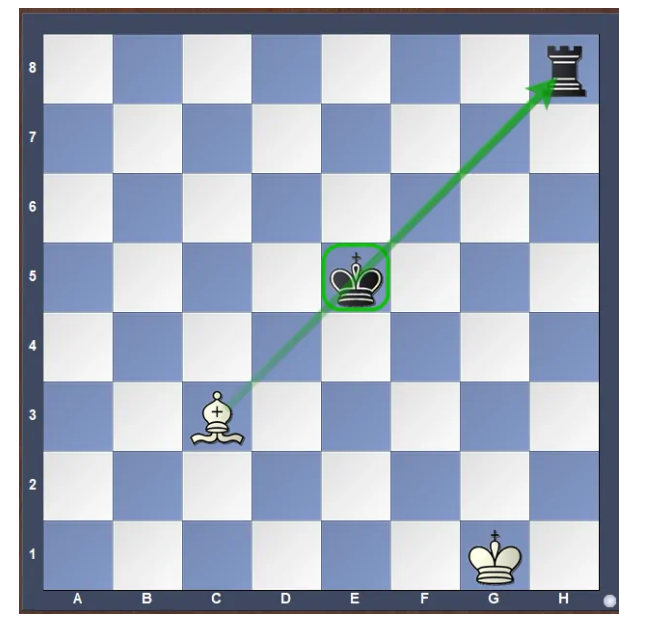
What is a skewer? A skewer in chess is an attack where a powerful piece, like the queen, rook, or bishop, aims at two of the opponent’s pieces lined up. The piece in front has to move to safety, leaving the piece behind open to capture.
Here is picture of skewer, it occurs often in our daily chess games.
For details with exemplary chess games, you may visit this link: https://chessrewards.com/skewers-in-chess/
Hunt F2/F7 Pawn in the Opening
In the opening, the weakest square on the board is f2 or f7, because its not protected by any other piece. Here is the picture of highlighted F2/F7 pawn.
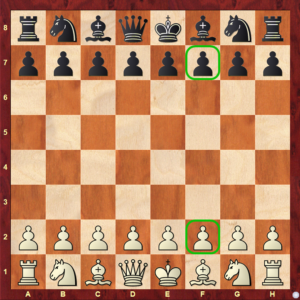
Let’s see this pattern in real chess game and you can learn how to do it practically.
Now you can see, how white applied this tactical motif on black’s player.
The tip is that you can try this motif, when you have advantage in development, like you have developed your minor pieces and your opponent did not.
Castling on Opposite side
Yes you read it right, if you are a attacker and want to win game with attack , attack, attack, and win, then you can apply this motif in your game, but there is one condition to it.
The condition is, if your opening theory allows you to castle on the opposite then you can apply this attacking motif in your chess games.
This theme often occurs against Sicilian Defense, so if you are E4 player then here is an example for you.
I hope now you got the point, but you have to remember the rule which is, if your opening theory allows you to castle on opposite side, then you must try this pattern in your real chess game.
For more details of castling you can visit this link: https://chessrewards.com/how-to-castle-in-chess/
The Greek Gift
This is my favorite pattern in tactics, in this pattern you need three pieces to deliver checkmate or winning a huge material advantages.
Number one thing you should know is when you have your pawn on E5.
Because when you have a e5 pawn then his king’s defender knight will not sit on f6 square, that is the number one condition for applying greek gift.
Second condition is, you can sacrifice your bishop on h7, and where black has to take back with king.
Third condition is that your knight f3 can jump to g5 delivering a check to king.
Fourth and last condition is that your queen can join the attack via d3 or g4.
Let’s see all above theory in action.
This is the position where all 4 conditions became true. Here is a tip for finding quick check on greek gift.
When you see your pawn on E5, then you must check 4 conditions in your mind and try it.
Conclusion
In conclusion, chess strategies and chess tactics are connected together, and you should learn these topics one by one.
About the solving puzzles, you must learn theory and motif behind it, if you learn with patterns it will help you a lot in your practical chess games.