The Bishop’s Opening begins 1.e4 e5 2.Bc4. White develops the bishop towards f7 and keeps the option of playing d3, Nf3 and castling. White’s attack succeeds when Black chooses the wrong king retreat. Taking the e4-pawn does not, by itself, lose the game.
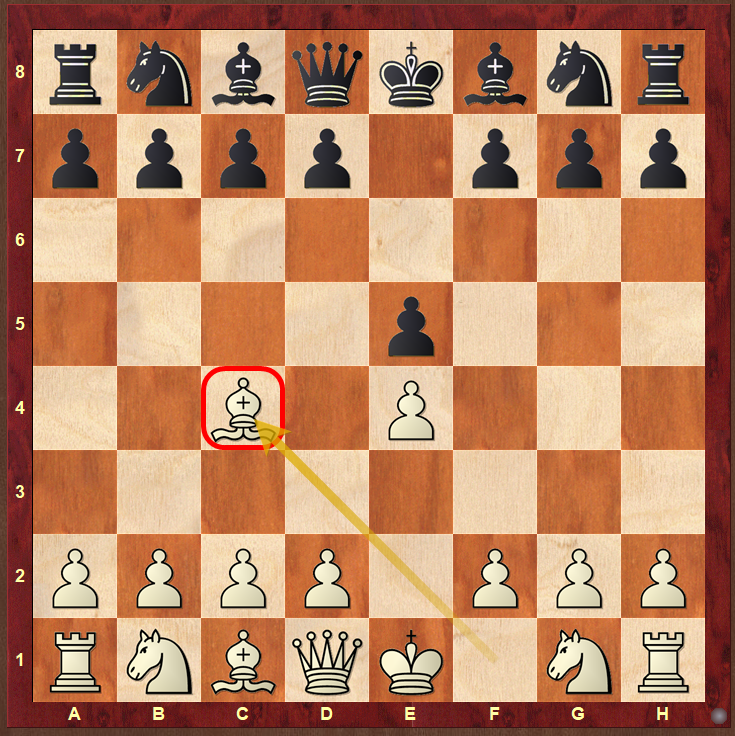
The seven-move example
After 2…Nf6 3.Nc3, play has transposed into a Vienna Game position. Black takes on e4 and White replies with a bishop sacrifice on f7. Play through the line, then stop after 7.Ng5 to work out the threat.
The exchange on f7 draws Black’s king away from e8. White then recovers the knight with 5.Nxe4. After 5…Nc6 6.Qf3+, Black can still defend. The retreat 6…Kg8 is the error that gives White a winning attack.
What does 7.Ng5 threaten?
The knight protects f7, so White threatens Qf7#. Black’s own bishop on f8 and rook on h8 help trap the king on g8. For example, 7…h6 fails to 8.Qf7#: attacking the knight is too slow.
Black can stop that immediate mate with 7…Qf6, but White has a second threat: 8.Qd5+ forks the king on g8 and the knight on c6. The queen reaches the d5 square through e4, which the knight has just vacated.
In the line 7…Qf6 8.Qd5+ Qe6 9.Nxe6 dxe6, Black gives up the queen for a knight. The attack has won material even though the game has not ended in checkmate.
How Black can avoid it
After 5.Nxe4, Black can play 5…d5 and attack White’s knight while opening lines for the bishops. One playable continuation is 6.Nc3 c6 7.Nf3 Bd6. Black should continue developing and arrange king safety before grabbing more material.
Even after 5…Nc6 6.Qf3+, the king can return to e8 instead of g8. That defence avoids the specific Ng5 trap. White must calculate the king’s replies before offering the bishop.
Use the idea in your own games
Look for a queen check that attacks another piece at the same time. Here, Ng5 first threatens mate and then clears the route to d5. If Black chooses a different reply earlier, calculate again instead of following the trap from memory.
For more examples of double attacks, read forks in chess. Our e4 opening guide covers the wider opening choices.
