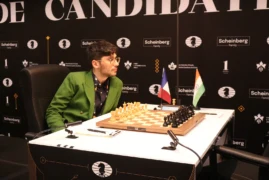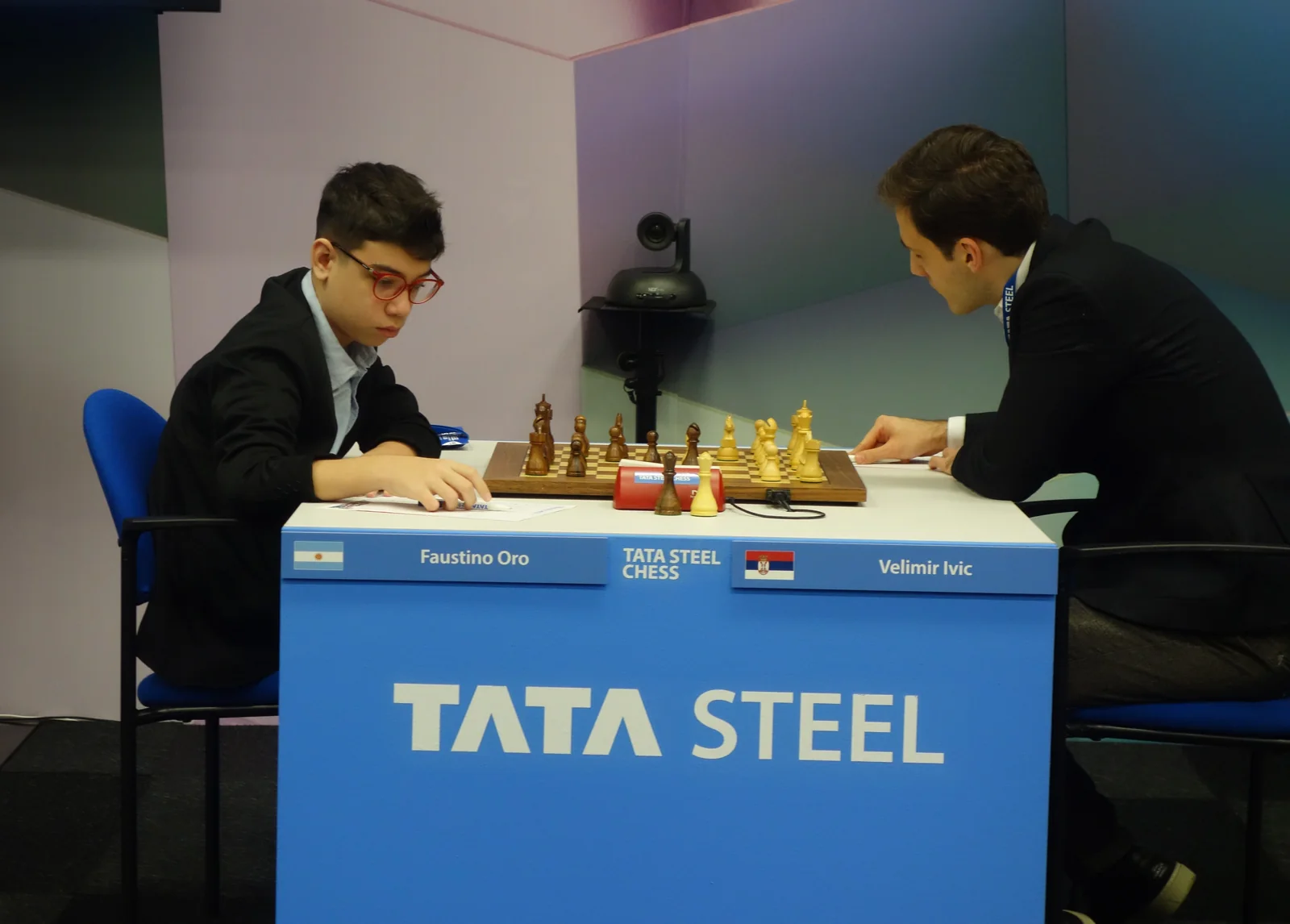
Faustino Oro continues to establish new benchmarks across classical and online chess. In Round 2 of the 2026 Tata Steel Chess Challengers in Wijk aan Zee, the 12-year-old Argentine faced Dutch grandmaster Erwin l’Ami. Playing White in the King’s English Variation, Oro displayed exceptional positional maturity. He converted a spatial edge into a decisive kingside bind, forcing resignation on move 36.
Follow live tournaments and browse available replays on ChessMars.
From Youngest International Master to 3300 Blitz
Oro’s competitive rise has set records across the chess world. Born on October 14, 2013, he earned the International Master title on June 30, 2024 at just 10 years, 8 months, and 16 days old. That achievement made him the youngest International Master in history, as documented in his official FIDE profile. He then earned three grandmaster norms across tournaments in Madrid, Buenos Aires, and Sardinia. In May 2026, at 12 years, 6 months, and 26 days, he became the second-youngest grandmaster in history.
His tactical speed and sharp intuition translate directly to fast online formats. On August 31, 2026, Oro crossed the 3300 blitz rating mark on Chess.com. That rating surge placed him among the platform’s all-time top 10 blitz players. This balance of classical patience and rapid calculation provides great study material for players pursuing our roadmap to 2000 rating.
Opening Setup: Maneuvering with 5.Ng1
Erwin l’Ami selected an ambitious setup with 3…f5 and 4…e4, seeking early kingside space. However, Oro remained composed against Black’s forward pawns. Rather than placing his knight on an awkward square, White chose 5.Ng1. This retreat appears counterintuitive because modern opening manuals emphasize forward development, but here it serves a clear strategic goal.
By returning the knight to g1, White avoids giving Black easy targets for attack. Furthermore, the move exposes Black’s advanced e4 pawn as overextended. Oro then rerouted his minor pieces smoothly, developing his bishop to d2 and maneuvering his knight toward f4. Consequently, Black struggled to reinforce his center without conceding outposts.
The Central Strike and the e6 Passed Pawn
As the middlegame developed, l’Ami searched for active counterplay on the kingside. Nevertheless, Oro controlled the central squares with patient piece placement. On move 23, White struck in the center with 23.e4, opening lines and activating his heavy pieces. Black attempted to complicate the struggle with 23…Ng4, but White’s king stepped safely to h1.
On move 27, Oro advanced with 27.e5, quickly followed by 28.e6. This protected passed pawn split Black’s army in two. Black’s light-squared bishop remained locked behind friendly pawns on e8, while White’s rooks doubled comfortably along the open d-file. As highlighted in our guide to chess strategies and tactics, an advanced wedge pawn restricts opponent coordination decisively.
Tactical Breakthrough: 35.Bc6 Deflection
With White controlling the board, l’Ami contested the d-file with his remaining rooks. However, Oro found an elegant tactical deflection that concluded the contest cleanly.
Position before move 35. White to move.
Show the candidate line and explanation
35. Bc6 Rxd3 36. Rxd3 Nf7 37. exf7+ Rxf7 38. Re3 Qxe5 39. Rxe5 Kg7 40. Kh2 Rf8
White seizes full control of the open d-file with the deflection 35.Bc6!, dislodging Black's rook from d8 and securing entry along the file.
By playing 35.Bc6, White attacked Black's rook on d8 while threatening an immediate infiltration. Black could not take the bishop because White would dominate the d-file after exchanging rooks. Following 35...Rxd3 36.Rxd3, l'Ami resigned, since White's rooks and unstoppable passed pawn leave Black without defense.
Faustino Oro vs. Erwin l'Ami: Full Game Replay
Examine the complete 36-move game below to see how positional patience leads directly to tactical execution:
Practical Takeaways for Competitive Players
Tournament players can apply two helpful strategic ideas from Oro's victory:
First, knight retreats can be the most effective response against early pawn storms. Oro's 5.Ng1 preserved harmony and prevented tactical weaknesses, which reflects principles taught in our guide to e4 chess openings. Second, passed pawns achieve maximum impact when supported by active heavy pieces. Once Oro planted his pawn on e6 and seized the d-file, Black had no counterplay.