Most club and online chess games end on a single careless move rather than a deep combination. One player leaves a knight without protection, walks into a quiet queen fork, or shuts their own bishop behind a row of pawns.
Knowing how to stop blundering pieces in chess comes down to breaking those habits before fatigue takes over. Even world champions drop full pieces when their pre-move routine slips, so building a quick safety check before every turn protects your score far better than memorizing another opening trap.
We will pair that three-step check with five grandmaster games where one specific blind spot cost the game, plus five interactive puzzles straight from those exact boards.
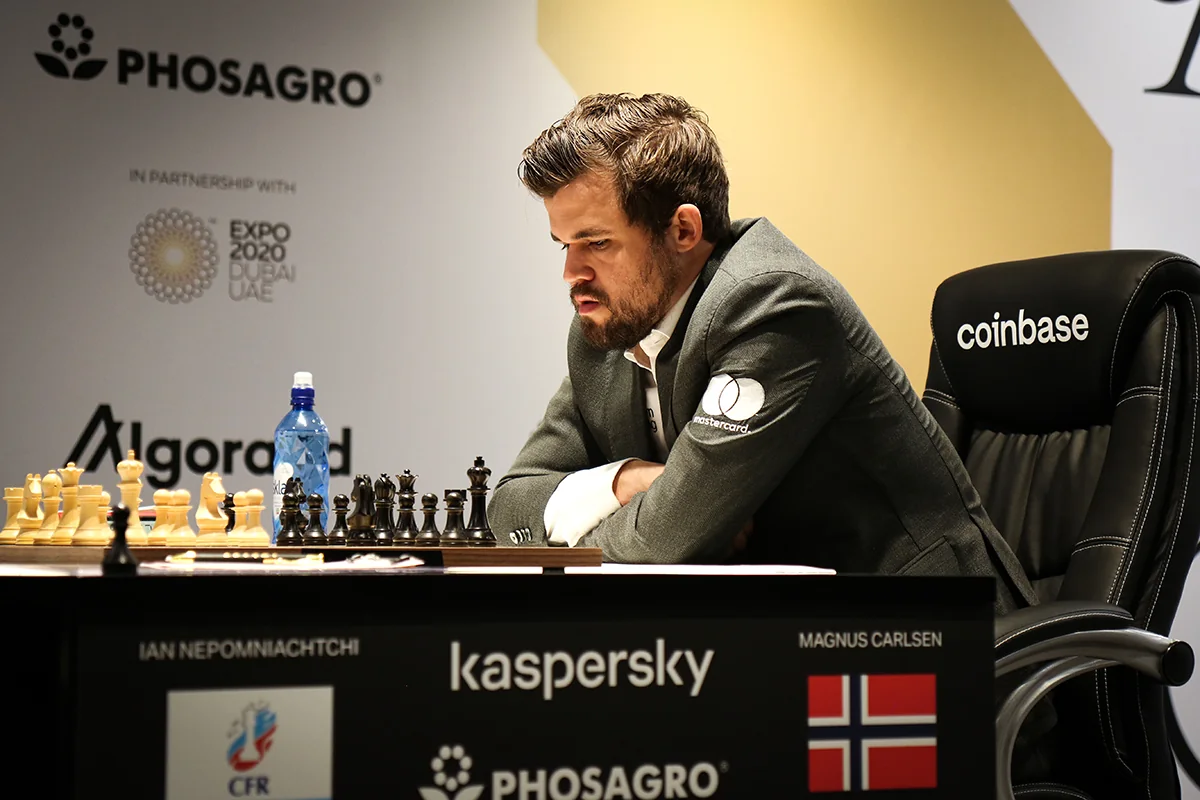
Why Good Players Still Drop Whole Pieces
When you lose a rook or bishop in one move, your calculation skill is usually fine along the single variation in your head. The mistake happens because your eyes stay locked on your own plan and skip a quick check outside that corridor.
Five habits explain nearly every sudden drop of material at club level and in grandmaster events. Sometimes a minor piece sits away from the action on a flank square with zero backup. Other times, chasing an attack hides what your opponent’s latest move just targeted, or you push a pawn forward and seal off your own bishop’s exit.
Skipping the opponent’s forcing replies right after choosing your candidate move creates a fourth blind spot, especially when they just played quickly. Late in long endgames, tired defenders also fall back on automatic rules of thumb and trade into lost king-and-pawn races.
Separate Blunders From Subtle Positional Slips
Treating every mistake alike makes blunder prevention feel hopeless. Putting a rook on a slightly passive file might cost a quarter-pawn over twenty moves, while placing a bishop where a queen retreat forks two pieces ends the game immediately.
Cutting out one-move drops takes a short pause right when a position looks harmless and a routine move feels obvious. Autopilot strikes hardest in calm positions, because sharp sacrifices already keep your guard up.
A Three-Step Check for How to Stop Blundering Pieces in Chess
Strong masters store thousands of patterns in memory, yet good coaches drill the same three-question routine with improving players every week. Pause for five seconds before your hand leaves your lap and check these three points in order.
Step 1: Look at Your Opponent’s Checks, Captures, and Threats First
Start with your opponent’s latest move and ask what changed across the board. A knight hop may have opened a hidden bishop diagonal, or a quiet pawn advance may now defend a square you planned to take.
Then visualize your candidate move sitting on its new square and scan your opponent’s replies. Look for checks against your king, captures of anything left unguarded, and new double attacks opened by the square you just cleared.
Step 2: Scan for Loose Pieces and Overloaded Defenders
Coaches repeat the phrase “loose pieces drop off” because undefended knights, bishops, and rooks act as magnets for sudden tactics. Two unguarded pieces standing across the board can fall to a single backward queen move or quiet check.
Keep an eye on lonely defenders carrying two jobs at once. If one pawn or bishop holds two squares together, an exchange or deflection strips that protection away and drops the second target next move. Reading through chess strategies and tactics sharpens your eye for overworked defenders early.
Step 3: Check Retreat Squares and Refuse Routine Trades
Pushing a knight or bishop into enemy territory feels active, so players often skip asking where that piece retreats if a simple pawn attacks it. Trace two safe squares backward before stepping past the fourth rank.
Bring that same skepticism to piece trades in cramped defenses. Swapping rooks often eases pressure, yet one hasty exchange can strand a cornered bishop or hand your opponent an easy pawn race.
Game 1: Loose Pieces and Backward Moves (Christiansen vs. Karpov, 1993)
At the 1993 Hoogovens tournament in Wijk aan Zee, former World Champion Anatoly Karpov lost a full piece in just twelve moves against American Grandmaster Larry Christiansen. One overlooked queen retreat turned a normal opening into an instant resignation.
Playing the Queen’s Indian Defense, White chose a3 and Qc2 to control e4 while preventing a pin on the c3-knight. Black fought for the light squares with 4…Ba6 and 5…Bb7, swapped knights on c6, and jumped 10…Nh5 to chase White’s bishop off f4.
Christiansen dropped the bishop back to e3 on move eleven, leaving Black’s knight stranded on the rim at h5 without a defender. Black needed a solid stabilizing move like 11…Bc5, yet Karpov wanted quick pressure along the b8-h2 diagonal first.
Why One Quiet Retreat Ended the Game
Developing 11…Bc5 challenges the strong e3-bishop and holds the balance near +0.42 in engine evaluation. Instead, Karpov played 11…Bd6?? and placed a second minor piece on an unguarded square.
Humans naturally scan forward along diagonals when checking moves, so a queen tucked away on c2 looks passive toward the kingside. Christiansen stepped back with 12. Qd1!, attacking the loose bishop down the d-file while targeting the loose knight on h5 along the d1-h5 diagonal.
Because Black could save only one piece, Karpov resigned after move twelve, a classic miniature examined in Chess.com’s lesson on double attacks and Grandmaster Rafael Leitao’s game notes. Checking forward squares fooled Black into leaving h5 unguarded while forgetting that queens strike just as hard moving backward.
Puzzle 1: Punish Two Undefended Minor Pieces
White to move right after 11…Bd6??. Find the Black pieces sitting with zero protection, then play the queen move that wins material on the spot.
Position before move 12. White to move.
Show the candidate line and explanation
12. Qd1 Be5 13. Qxh5 Bxc3+ 14. bxc3 Qf6 15. e5 Qg6 16. Qxg6 hxg6 17. f3 Rh5
The queen drops back to d1 to attack the unguarded bishop on d6 down the d-file and the loose knight on h5 along the d1-h5 diagonal at the same time. After 12...Be5 13. Qxh5, White wins a full piece.
Game 2: Tunnel Vision and Opponent Time Trouble (Petrosian vs. Bronstein, 1956)
Watching an opponent scramble with seconds left on the clock can throw off your own rhythm just as fast as being in time trouble yourself. During round two of the 1956 Candidates Tournament in Amsterdam, Tigran Petrosian crushed David Bronstein for thirty-five moves before throwing away a winning game in one turn.
Out of a calm English Opening, Petrosian traded dark-squared bishops on g7, locked down the queenside with a4 and a5, planted strong knights on d5 and e4, and pushed his queen into d6. Black stood nearly paralyzed with almost no clock left to navigate the maze.
White held an extra pawn and complete board control, needing only steady consolidation to collect the point. Watching Bronstein hurry under flag pressure pulled Petrosian into rushing as well, eyes locked strictly on his next attacking jump.
When Attacking Ideas Hide a Hanging Queen
With 35...Nf5, Bronstein hit White's queen directly on d6. Retreats like 36. Qa3 (+3.11) or 36. Qc7 (+3.10) hold a winning margin while keeping Black bottled up on the back ranks.
Petrosian spotted a tempting jump with 36. Ng5?? to eye the e6 square, leaving his queen hanging right on d6. Bronstein snapped off 36...Nxd6, and Petrosian resigned at once, an upset revisited in FIDE's historical tournament review.
When an opponent drops under a minute, slow your own breathing down instead of matching their panic. Put defensive safety ahead of flashy tactical knocks, and check what their desperate last move attacked before touching anything. For daily training habits that stick after games like this, check our guide on how to get better at chess for beginners.
Puzzle 2: Save the Crushing Advantage Before Pressing Forward
Black's knight just hopped to f5, threatening the White queen on d6. Play White's cleanest safe retreat on the board below to preserve the winning advantage instead of blundering with 36. Ng5 (36. Qc7 holds a similar edge).
Position before move 36. White to move.
Show the candidate line and explanation
36. Qa3 Re8 37. Kg1 Nf8 38. Rb6 Nd4 39. Rxa6 Bf5 40. Rab6 g5 41. hxg5 Nfe6
Black's knight on f5 just attacked the queen on d6. Stepping safely back with 36. Qa3 preserves White's extra pawn and complete positional control instead of blundering the queen with 36. Ng5.
Game 3: Skipping the Counter-Scan Twice (Carlsen vs. Anand, 2014)
World championship matches rarely turn on two missed tactics inside two minutes, yet Game 6 in Sochi in 2014 delivered that exact shock. Magnus Carlsen and Viswanathan Anand both skipped basic blunder checks on consecutive turns.
Out of a Sicilian Kan where queens disappeared on move nine, Carlsen pressed against Black's split queenside pawns and stacked his rooks down the g-file and h-file. Around move 26, White held comfortable pressure against g6 and looked to step his king off the back rank.
Why Assuming Your Opponent Played Well Hurts You
Carlsen took 63 seconds before moving 26. Kd2??, swinging a healthy +0.38 edge after 26. Kd1 straight down to -1.99 for Black. Sixty seconds later, Anand pushed 26...a4??, missing a winning tactical shot and going on to lose the game.
Commenting on the double miss in Chess.com's Game 6 report, Grandmaster Peter Svidler summed up the moment bluntly: "As usual the one move you make instantly in the game is the one you should have been thinking about." Anand trusted Carlsen's judgment and assumed the king move was sound, so he never checked forcing captures on e5.
Club players make that same mistake every weekend. Whenever an opponent plays calmly in under a minute, trusting their calculation makes you skip checking whether their move just left a central pawn unguarded or stepped onto a fork.
Puzzle 3: Spot the Knight Sequence Anand Missed
Play Black's winning three-move reply right after 26. Kd2?? on the board below.
Position before move 26... Black to move.
Show the candidate line and explanation
26...Nxe5 27. Rxg8 Nxc4+ 28. Kd3 Nb2+ 29. Kd2 Rxg8 30. g3 Nc4+ 31. Ke2 Bd5 32. Bc1
Black spots the unprotected e5-pawn and White's exposed king: 26...Nxe5 hits the g4-rook, and after 27. Rxg8 Nxc4+ 28. Kd3 Nb2+ wins the c4-pawn and stays up two pawns after 29. Kd2 Rxg8.
Treat your opponent's rating and smooth rhythm as irrelevant once the clock runs. Every turn shifts piece alignment and pawn cover, so scan loose pawns and exposed checks on every single move.
Game 4: How to Stop Blundering Pieces in Chess by Checking Escape Squares (Nepomniachtchi vs. Carlsen, 2021)
Some piece blunders leave your minor piece fully guarded on the move you play, then trap it two turns later because your own pawn sealed off its way back. Game 9 of the 2021 World Chess Championship in Dubai gave an unforgettable demonstration.
Ian Nepomniachtchi held his own out of a complex English Opening, traded queens on e1 on move 24, and snatched a pawn with 26. Bxb7. Magnus Carlsen hit back with 26...Ra4, pressuring c4 while White's bishop sat tucked far inside Black's queenside.
Watch What Your Pawns Shut Out
White held full equality after 27. f3 (+0.24), kicking Black's knight away from g4 and leaving the a6-f1 diagonal clear for the bishop's escape. Pushing 27. c5?? looked natural to guard c4 and advance the queenside majority.
Unfortunately, the pawn on c5 landed right across the b7-bishop's escape route via d5 and e4. Carlsen immediately played 27...c6!, locking the door on b7, and swung 29...Ra7 and 30...Rb8 to win the stranded bishop, dropping White to -1.94 on 27. c5?? and -2.03 after 27...c6, as analyzed in Chess.com's Game 9 report and Wesley So's ChessBase notes.
Whenever a bishop or knight crosses onto your opponent's half of the board, treat its retreat squares as your lifeline. Before advancing a pawn nearby, check that your piece still has an open lane back toward safety.
Puzzle 4: Lock In the Stranded Bishop
Find Black's winning plan on the interactive board after 27. c5??.
Position before move 27... Black to move.
Show the candidate line and explanation
27...c6 28. f3 Nh6 29. Re4 Ra7 30. Rb4 Rb8 31. Nd2 Rbxb7 32. Rxb7 Rxb7 33. a4
After 27. c5??, Black plays 27...c6 to lock the White bishop on b7. After 28. f3 Nh6 29. Re4, Black brings the rooks to the b-file with 29...Ra7 and 30...Rb8 to win the trapped piece.
Crowding your own squares also sets up tactical accidents like pins and skewers in chess when pieces lack room to step aside. Checking two squares backward prevents self-traps before they form.
Game 5: Endgame Autopilot and Routine Trades (Ding Liren vs. Gukesh D, 2024)
Late in a five-hour battle, tired defenders often lean on general chess guidelines instead of calculating a concrete trade. Game 14 of the 2024 World Chess Championship in Singapore showed how deadly that habit can be when one exchange flips a draw into resignation.
Defending champion Ding Liren spent hours holding a difficult, pawn-down position against 18-year-old Gukesh Dommaraju. Queens disappeared on move 30, opposite-colored bishops reached the board after 31. Ra8 Rxa8, and Black squeezed patiently down to move 55.
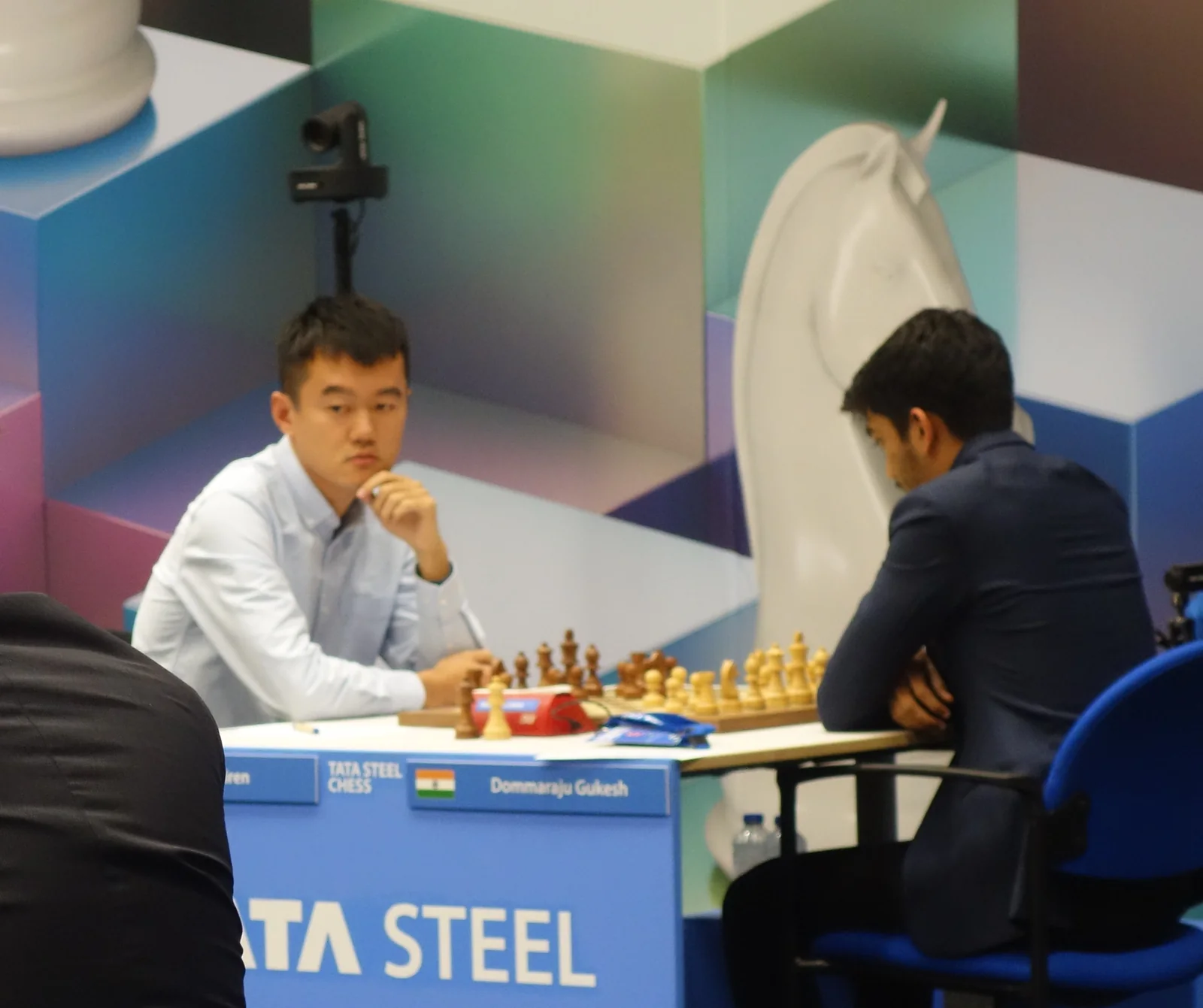
Photographed above at Tata Steel Chess 2023 in Wijk aan Zee nearly two years before Singapore, both players were already used to testing each other in long endgames. By move 55 in Game 14, Ding had virtually secured a draw where 55. Bg2 keeps the evaluation near -0.28. Hoping to eliminate Black's active second-rank rook, he followed the common endgame rule of trading pieces when defending down a pawn and played 55. Rf2??.
Why Heuristics Fail When Pieces Lock Together
Because White's bishop sat stuck in the corner on a8, trading rooks allowed 55...Rxf2 56. Kxf2 Bd5!, pinning the trapped bishop into a forced swap. Once both bishops came off on d5, Black's centralized king outraced White's king to the kingside pawns.
In Chess.com's Game 14 report, Gukesh admitted he almost avoided the rook trade automatically before spotting the forced bishop liquidation, calling the moment he saw the win "probably the best moment of my life!" Stockfish 18 Lite swings the position from -0.28 after 55. Bg2 straight to -14.79 on 55...Rxf2, since refusing the second swap with 56. Bc6 loses cleanly to 56...Rc2.
Puzzle 5: Break the Automatic Rook-Check Habit
Keeping checks going with 55...Rb1+ feels safe, yet it drops most of Black's edge. Play Black's exact exchange sequence on the board below right after 55. Rf2??.
Position before move 55... Black to move.
Show the candidate line and explanation
55...Rxf2 56. Bc6 Rc2 57. Ba4 Ra2 58. Bb5 Bd5 59. Kf1 Rg2 60. Ke1 Rxg3 61. Kd2
Trading rooks with 55...Rxf2 wins because 56. Kxf2 allows 56...Bd5!, forcing a bishop swap into an easily won king-and-pawn endgame. Refusing with 56. Bc6 loses to 56...Rc2 as Black keeps an extra rook or promotes.
Clock Discipline and Habits That Hold Up Under Pressure
Spotting why pieces fall in championship games gives you clear targets, yet mental discipline breaks down on weeknight games unless your routine holds under clock pressure. Good habits protect your rating when your focus dips after move thirty.
Pause at Mechanical Danger Points
Over the board, FIDE touch-move rules commit you the instant your fingers graze a piece, so leave your hand off the table until every check, capture, and escape square clears inspection. Online, disable blind premoves in messy middlegames and switch on move confirmation for two weeks if rushed clicks keep costing you pieces.
Blunders spike right when the position shifts gears: leaving opening theory, snagging a wing pawn, entering a rook endgame, or watching an opponent fall under thirty seconds. Whenever the board changes character, invest ten extra seconds sweeping for loose defenders before playing a routine reply.
Build a Weekly Anti-Blunder Routine
Nonstop bullet and short blitz hide tactical holes because opponents miss half of your drops too. Play at least three longer rapid or classical games per week, such as 15+10 or 30+0, so your three-step check becomes second nature.
After each session, locate your worst material blunder before opening an engine. Write down the exact blind spot that caused it: a missed backward queen move, a blocked retreat path, or an automatic endgame trade. For more practical training drills between games, browse our chess tips for beginners guide.
Five-Game Blunder Audit Checklist
| Game and Year | Critical Blunder | Root Cause | Correct Preventive Check |
|---|---|---|---|
| Christiansen vs. Karpov (1993) | 11...Bd6?? | Two undefended minor pieces | Spot loose pieces and backward queen retreats |
| Petrosian vs. Bronstein (1956) | 36. Ng5?? | Tunnel vision against time trouble | Check what the opponent's last move attacked |
| Carlsen vs. Anand (2014, Game 6) | 26. Kd2?? and 26...a4?? | Skipped counter-scan and blind trust | Check opponent captures on every turn |
| Nepomniachtchi vs. Carlsen (2021, Game 9) | 27. c5?? | Blocking a piece's own retreat | Trace two escape squares before pushing pawns |
| Ding vs. Gukesh (2024, Game 14) | 55. Rf2?? | Endgame trading autopilot | Calculate the resulting pawn race before swapping |
Eliminating piece blunders takes steady attention over months of serious games, since tiredness brings old shortcuts back fast. Keep scanning checks, captures, and threats for both sides, guard loose pieces early, and give calm positions five seconds of honest thought before you move.
Download game 1 PGN · Download game 2 PGN · Download game 3 PGN · Download game 4 PGN · Download game 5 PGN

[…] a durable competitive foundation. If you also struggle with tactical blunders, reading our guide on how to stop blundering pieces in chess will provide immediate companion […]