Every ambitious chess player wants to know how to analyze their own games effectively. Most players finish a game on an online server, immediately click the analysis button, and scan the evaluation graph. When the computer flags a mistake with an exclamation mark or question mark, they glance at the suggested move, nod, and jump into the next pairing. That habit creates the illusion of learning while stalling real rating growth.
Grandmaster training operates on a different standard. True chess development requires understanding why a mistake happened, which ideas you overlooked during calculation, and how your thinking process failed under competitive pressure. When you let an engine supply answers before your brain reconstructs the game, you bypass the cognitive struggle where pattern recognition and strategic intuition develop.
In this comprehensive guide, you will learn a structured five-step post-mortem method used by classic world champions and modern grandmasters. Furthermore, we examine five landmark games with annotated PGNs and interactive exercises that teach you how to identify critical moments, calculate candidate moves, diagnose tactical oversights, and maintain healthy engine discipline.
The dangers of unguided engine analysis
Computer engines evaluate millions of positions per second with superhuman precision. However, an engine cannot explain your human doubts, time pressure, or strategic misconceptions. A minus-three evaluation number tells you that a position is lost, but it does not tell you why you chose a passive knight retreat instead of an active central counterstrike.
When you rely on engine evaluations too early, three serious problems emerge:
- You memorize tactical fixes for specific positions without grasping the underlying positional causes.
- You develop passive calculation habits because the computer does the mental heavy lifting for you.
- You fail to detect your recurring psychological triggers, such as rushing in winning positions or panicking in mutual time scrambles.
Consequently, the golden rule of chess self-improvement is simple: analyze your game with your own mind first, record your unfiltered thoughts, and only then consult the engine to verify concrete tactical lines. If you want a structured foundation on avoiding recurring blunders, study our guide on how to stop making mistakes in chess.
The five-step post-game analysis protocol
To turn casual post-mortems into lasting chess skill, apply this repeatable five-step routine after every serious game.
Step 1: Write immediate post-game notes
Immediately after your game concludes, spend five minutes writing down your thoughts while your emotions and calculation memories are fresh. Note the moves where you felt uncertain, the moments where you spent too much time, and the plans you anticipated from your opponent. These psychological impressions disappear if you wait until the next day.
Step 2: Replay the game without computer assistance
Set up the game on a physical wooden board or a blank digital chessboard with all engine evaluations turned off. Replay the moves slowly. At each critical turn, identify candidate moves that you rejected during the game and try to calculate the consequences. Try to discover where the balance changed. This deliberate practice directly exercises your visualization and calculation muscles.
Step 3: Identify the turning point
Every decisive game contains one or two moments where the strategic character changed or the evaluation tipped. Your goal in this step is to find that specific decision. Was it an unnecessary pawn weakness? A passive piece exchange? A missed tactical shot? Pinpoint the exact move that altered the trajectory of the contest.
Step 4: Verify your findings with the engine
Now turn on your engine to check your independent conclusions. Compare your candidate lines against the computer choices. If the engine prefers a different path, ask yourself why. Did the engine spot an obscure tactical resource, or did it demonstrate a concrete flaw in your calculation? Use the engine to verify concrete facts instead of replacing your own thinking.
Step 5: Record lessons in your training notebook
Summarize the game in one or two actionable rules for your future play. For instance: “Do not castle into an open h-file when Black has an active light-squared bishop,” or “Calculate forcing checks before committing to a quiet pawn advance.” Recording these conclusions turns temporary pain into permanent knowledge. For broader rating benchmarks, review our roadmap on how to improve your chess rating.
Diagnosing the root causes of mistakes
A blunder on the board is rarely an isolated accident. It is usually the visible symptom of a deeper flaw in your thinking technique. When classifying your mistakes during post-game review, assign each error to one of five clear categories.
First, calculate tactical miscalculations. These occur when you missed an opponent defensive resource, miscounted piece exchanges, or failed to see a quiet intermediate move (zwischenzug). To strengthen this area, practice daily calculation drills with our lesson on how to improve chess calculation.
Second, identify strategic misconceptions. These mistakes arise when you choose the wrong plan: attacking on the flank while your center is unstable, opening the position when your opponent has the bishop pair, or trading into an inferior endgame structure.
Third, examine time management issues. When you spend twenty minutes on a routine opening decision, you inevitably find yourself blundering in mutual time trouble on move 35. Tracking move timestamps allows you to identify where you wasted precious clock resources.
Fourth, recognize psychological breakdowns. Complacency when holding a winning advantage and defeatism when defending a cramped position cost players hundreds of rating points. Pinpointing these emotional swings helps you build competitive resilience.
Fifth, detect opening knowledge deficits. If you consistently find yourself in uncomfortable middlegames by move 12, your opening preparation requires adjustment. Note the exact theoretical divergence so you can review master games in that specific variation.
Mikhail Botvinnik and the scientific analysis method
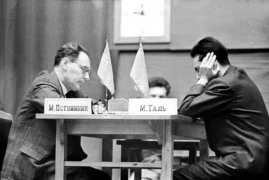
Mikhail Botvinnik, the sixth World Chess Champion and founder of the Soviet chess school, revolutionized game analysis. Botvinnik kept thorough notebooks where he dissected his tournament games with brutal honesty. He insisted on publishing his losses with detailed annotations so that competitors could challenge his conclusions. Botvinnik believed that a player learns far more from one deeply analyzed loss than from ten superficial victories.
A supreme example of Botvinnik’s analytical preparation is his victory over former World Champion Jose Raul Capablanca at the AVRO 1938 tournament. In a complex Nimzo-Indian defense, Botvinnik constructed a long-term central offensive based on pushing e3-e4. He anticipated that Capablanca would seek counterplay on the queenside by picking up the a4 pawn. Botvinnik had calculated that White’s central pawn roller and kingside attacking lines would outweigh Black’s queenside material gains.
On move 30, Botvinnik unleashed a historic deflection sacrifice: 30. Ba3! White offers the bishop to pull the black queen away from defending the critical e7 and e8 squares. When Capablanca captured the bishop with 30… Qxa3, Botvinnik followed with 31. Nh5+!!, shattering Black’s defensive structure and forcing resignation eleven moves later.
Study how Botvinnik evaluated the position before executing the combination. White did not launch the attack impulsively. Instead, White built harmonious piece coordination across twenty moves before striking. Test your ability to find White’s decisive breakthrough in the puzzle below.
Position before move 30. White to move.
Show the candidate line and explanation
30. Ba3 Qe8 31. Qc7+ Kh8 32. Be7 Kg7 33. Bd8+ Kf8 34. Bxf6 Qxe6 35. Bg5 a5
White deflects Black's queen or forces Black into passivity with 30. Ba3, clearing e5 for decisive tactical threats.
Calculating candidate moves in the Morphy Opera Game
Alexander Kotov's classic analytical framework emphasizes generating a complete list of candidate moves before calculating concrete variations. When analyzing your games, you must examine whether you considered all plausible candidate moves on each critical turn or fixated on the first idea that caught your eye.
Paul Morphy demonstrated the supreme power of candidate move calculation in his famous Opera Game against the Duke of Brunswick and Count Isouard in Paris in 1858. Faced with Black's passive Philidor Defense, Morphy evaluated every turn through the lens of rapid piece mobilization and open lines. While Black wasted tempos grabbing pawns and defending weaknesses, Morphy brought every minor piece and rook into the battle with tempo.
On move 10, Morphy calculated that sacrificing a piece on b5 with 10. Nxb5! would blow open the center and prevent Black's king from reaching safety. Then, on move 16, Morphy crowned the game with a majestic queen sacrifice, deflecting Black's defending knight to deliver checkmate with his remaining rook.
When you review your own games, look for positions where you chose slow defensive retreats instead of dynamic candidate moves. Ask yourself: could an active pawn break or tactical sacrifice have seized the initiative? Solve Morphy's final tactical strike below to sharpen your candidate move vision.
Position before move 16. White to move.
Show the candidate line and explanation
16. Qb8+ Nxb8 17. Rd8#
White deflects Black's sole defending knight with the queen sacrifice 16. Qb8+ Nxb8 17. Rd8#, delivering back-rank mate.
Isolating the critical moment in Karpov vs Kasparov 1985
A common mistake in amateur game analysis is spending hours looking at the final blunder while ignoring the subtle strategic shift that made the blunder inevitable. Games between elite grandmasters teach us to search for the real turning point where one side gained structural dominance.
In Game 16 of the 1985 World Chess Championship in Moscow, Garry Kasparov played the Black pieces against Anatoly Karpov. Karpov chose a quiet Sicilian system, but Kasparov launched an ambitious central pawn break with 8... d5. By move 16, Kasparov planted a dominant knight on d3, often described by commentators as the octopus knight. That single outpost paralyzed White's entire army.
The critical moment occurred between moves 14 and 16. Karpov failed to challenge Black's central control, allowing Kasparov to seize total command of the dark squares. Once the knight took root on d3, Karpov's rooks were disconnected, his kingside was weakened, and Black's tactical blow 34... Nf2+! decisively wrapped up the victory.
When analyzing your games, identify the moment where an opponent piece established an unchallengeable outpost. Determine which pawn push or piece trade allowed that square to become available. Test your tactical alertness in Kasparov's finishing combination below.
Position before move 34... Black to move.
Show the candidate line and explanation
34...Nf2+ 35. Rxf2 Bxd3 36. Rfd2 Qe3 37. Rxd3 Rc1 38. Rd7 Rxd1+ 39. Rxd1 Qxb3 40. Rf1
Black unpins the bishop and crashes through with the knight fork 34...Nf2+, winning White's queen after 35. Rxf2 Bxd3.
Objective evaluation versus wishful thinking in Fischer vs Spassky 1972
Psychologists and chess coaches know that wishful thinking is one of the most persistent barriers to improvement. Players calculate variations based on what they hope their opponent will play instead of searching for the opponent's strongest countermoves. Objective game analysis forces you to confront these biases.
In Game 6 of the historic 1972 World Chess Championship in Reykjavik, Bobby Fischer gave a masterclass in objective evaluation. Fischer surprised Boris Spassky by playing 1. c4, transposing into the Tartakower Variation of the Queen's Gambit Declined. Instead of hunting for speculative kingside fireworks, Fischer built pressure against Black's hanging pawns on c5 and d5.
Fischer calculated that Spassky's pieces lacked active counterplay. White methodically restricted Black's rooks, fixed the pawn structure, and launched the decisive breakthrough with 38. Rxf6! Spassky applauded Fischer's play alongside the audience at the game's conclusion because White's strategic conduct was flawless.
When you conduct your post-mortem, scrutinize every optimistic assumption you made during play. Ask yourself whether your opponent had a defensive resource that you simply ignored because it ruined your desired combination. Try your hand at Fischer's exchange sacrifice in the exercise below.
Position before move 38. White to move.
Show the candidate line and explanation
38. Rxf6 gxf6 39. Rxf6 Kg8 40. Rxh6 c4 41. Bxc4 Rxc4 42. bxc4 Rg7 43. Qd5 Re7
White sacrifices the exchange with 38. Rxf6! to dismantle Black's pawn fortress around the king, leaving Black completely defenseless.
Computer hygiene in modern chess study: Aronian vs Anand 2013
In the modern era, chess engines are indispensable tools, but they require strict hygiene. Top grandmasters use computers to test concrete novelties and verify tactical calculations, yet they never accept an engine evaluation without discovering the human idea behind it.
A prime example occurred in Round 4 of the 2013 Tata Steel tournament in Wijk aan Zee, reported in The Week in Chess 950, between Levon Aronian and Viswanathan Anand. In a sharp Semi-Slav Meran variation, Anand introduced an astonishing home preparation concept with 15... Bc5! and 16... Nde5!! White had won material on the queenside, but Anand calculated that Black's bishop pair and centralized knights exerted irresistible pressure against White's king.
An engine evaluates Anand's sacrifices with a steady positive score for Black, but playing these moves over the board requires deep human understanding of piece coordination and tempo. Anand did not simply remember computer lines. He understood why White's pieces were discoordinated and how Black's tactical sequence 17... Bxd4+! would break open White's defenses.
When reviewing your games with Stockfish or Leela Chess Zero, follow Anand's example: do not move on from a computer suggestion until you can articulate the tactical or strategic reason in plain words. Practice finding Anand's devastating strike in the exercise below.
Position before move 17... Black to move.
Show the candidate line and explanation
17...Bxd4+ 18. Kh1 Nxg4 19. Ng5 f5 20. h3 Rf6 21. Qe2 Rh6 22. Nf3 a6 23. Bd2
Black unleashes tactical threats with 17...Bxd4+ 18. Kh1 Nxg4, ripping open White's kingside and taking complete control of the initiative.
How to organize a personal mistake catalog
Analyzing games pays dividends only when the discoveries change your future tournament habits. To ensure your insights translate into rating gains, maintain an organized mistake catalog in a physical notebook or digital document.
Divide your ledger into four distinct tracking sections:
- Tactical blindspots: Record the specific motifs you missed, such as back-rank weaknesses, deflection tactics, knight forks, or decoy sacrifices.
- Endgame technique: Note technical errors in pawn endgames, rook activity mistakes, or failure to calculate king opposition correctly.
- Time trouble records: Log games where you spent excessive time on non-critical moves, noting the move number where your clock dropped below five minutes.
- Opening repertoire gaps: Document novelties and theoretical divergences so you can patch your preparation before your next competitive outing.
Review this mistake catalog once a week before your tournament games. Reminding yourself of past mistakes prevents you from repeating them under competitive tension. For additional guidance on calculating variations accurately, study our guide on how to calculate variations in chess.
Weekly game analysis schedule for working players
Many adult improvers struggle to find enough time to analyze every game they play. If you play several rapid or blitz games each evening, analyzing each one thoroughly is impossible. Therefore, you need a disciplined weekly schedule that prioritizes quality over sheer volume.
Follow this balanced weekly routine:
- Select your two most instructive games each week: Pick one hard-fought victory and one painful defeat with classical or rapid time controls.
- Dedicate 45 minutes of unassisted board analysis to each selected game: Reconstruct the variations, identify turning points, and write your personal comments.
- Spend 15 minutes checking both games with an engine: Verify tactical branches, understand why alternative moves failed, and note your calculation blindspots.
- Extract two concrete rules for your training ledger: Write down the specific takeaways that you will review before your next tournament round.
- Discard superficial blitz games: Do not waste limited study hours running engine checks on one-minute blitz games where blunders stem purely from time panic.
By following this methodical process consistently across several months, you will develop sharp tactical awareness, disciplined calculation habits, and deep strategic confidence. To test your pre-move verification habits in practical games, explore our checklist on what to look for before every chess move and learn how to find the best move in chess.
Download game 1 PGN · Download game 2 PGN · Download game 3 PGN · Download game 4 PGN · Download game 5 PGN