Today we will learn about How to create weakness in chess, creating weakness in chess is a fundamental aspect of chess strategy. By understanding and exploiting these weaknesses, you can gain a significant advantage and increase your chances of winning.
This article will guide you through various techniques to create and exploit weaknesses, illustrated with exemplary chess games.
What is a Weakness in chess?
In chess, a weakness refers to a structural or positional flaw in your opponent’s position. It can be a weak pawn, an exposed king, or even a piece that is poorly placed. Identifying and targeting these weaknesses can be the key to success.
Importance of Creating Weaknesses
Creating weaknesses in your opponent’s position helps you to control the game. It forces your opponent to defend and respond to threats, often leading to errors and mistakes. You can steer the game in your favor by systematically creating and exploiting these weaknesses.
How to create Pawn weakness in chess
The pawns are the soul of chess, I hope you heard this phrase before, and if you have an understanding of chess you know this phrase by heart.
Let’s bypass the theory and let’s learn how to find weakness in your opponent’s camp and how will you exploit it.
There will be two steps.
- One is finding a weakness.
- The second is exploiting.
That’s very easy, please pay attention to it, it will bring you a lot of success :).
How to find weakness in chess
When the pawn leaves its original position let’s say 1.e4 ( the pawn moved to 1.e4 and its original position was e2) if the pawn leaves its original position and does not have another pawn in support or is backed by another pawn then this pawn is a weakness because other pawns can not defend it.
Let me explain with a picture of the chessboard here. Can you find the weakness in the below picture, please take time and try to find the weakness there yourself.
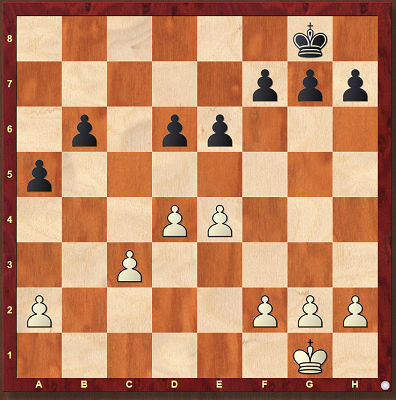
I hope you will find the weakness here if not then here it is the picture below.
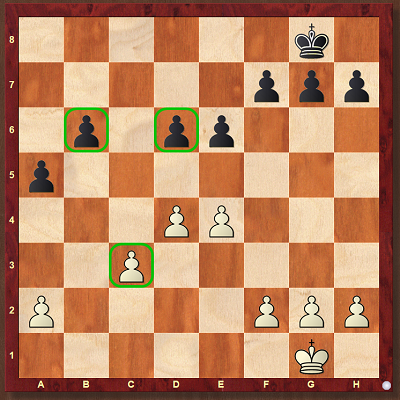
If the pawn is not supported by another pawn after moving from its original position then that’s what we call a weakness in pawns.
Now you found the weakness and let’s move to step 2 on how to exploit it.
How to create weakness in chess
To exploit weakness we must attack and win it or create another weakness. When your opponent has two weaknesses then his pieces will be tied down to defend and that’s your advantage.
Let’s watch the game and check how Peter Leko exploits the weakness in black’s camp.
After the last move king c6 black has no way to defend his weakness on b6.
Isolated Pawns
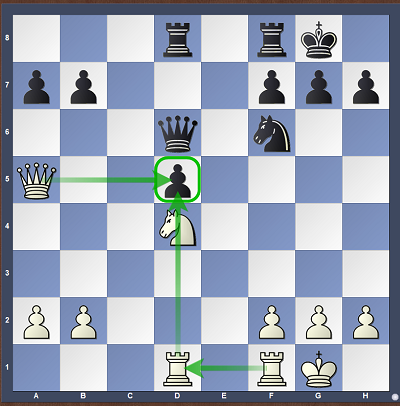
Isolated pawns are also a weakness but hard to crack until you know the theory. So when you have an isolated pawn, you should push that isolated pawn at the right time for two reasons, one is to get rid of the isolated pawn and the second is to open the position.
Doubled Pawns
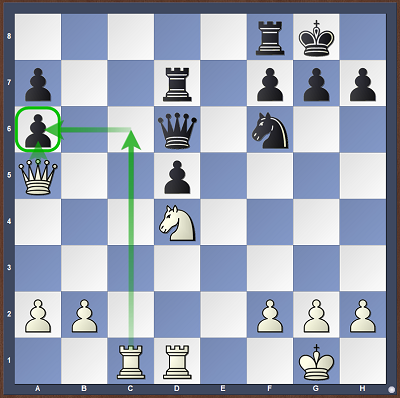
Doubled pawns occur when two pawns of the same color end up on the same file. They are generally weaker because they cannot protect each other.
In the opening, if your opponent succeeds in doubling your pawn that means you will have trouble the whole game, so keep an eye for your pawn structure and you can apply the same rule if your opponent has the doubled pawn.
Conclusion
Creating and exploiting weaknesses in your opponent’s position is a crucial skill in chess.
By understanding and implementing the strategies discussed in this article, you can improve your game and increase your chances of winning.
Whether it’s through creating pawn weaknesses, controlling open files, or employing tactical devices like pins and forks, these techniques will help you become a stronger player.
If you still have any questions feel free to ask.


![How to Win Chess in 4 Moves [Scholar’s Mate]](https://chessmars.com/blog/wp-content/uploads/2024/10/Qxf7-269x180.png)